A Speculative Framework for Inter-Brane Time Displacements
Christian Sacks
Independent Researcher – no formal physics training
1. Background
Brane cosmology posits that our observable universe is a $(3+1)$-dimensional brane embedded within a higher-dimensional bulk. Influential models—such as the Randall–Sundrum scenarios and ekpyrotic (colliding-brane) cosmologies—suggest that gravitational interactions may propagate through extra dimensions, while Standard Model forces remain confined to the brane.
These frameworks have offered compelling insights into problems such as:
- The hierarchy between gravitational and electroweak scales
- Early-universe dynamics and initial conditions
- The role of extra dimensions in cosmological evolution
Despite these advances, several observations remain only partially explained, most notably:
- Galactic rotation curves
- Large-scale structure formation
- The accelerated expansion of the universe
2. Motivation
Observational evidence indicates gravitational effects beyond those predicted by visible matter alone. Conventional approaches attribute these discrepancies to:
- Non-baryonic dark matter
- Modifications to General Relativity
This note explores an alternative possibility: temporal phase offsets between parallel branes. Such offsets may generate effective gravitational phenomena analogous to dark matter and contribute to the apparent energy density experienced on our brane.
3. Core Idea: Temporal Phase Offsets
I propose that parallel branes need not share identical time coordinates. Instead, each brane $i$ possesses its own proper time $t_i$, related to a bulk reference time $t$ via a spatially dependent phase function $f_i$ along the transverse (extra-dimensional) coordinate $x_\perp$:
$$ t_i = t + f_i(x_\perp) $$
Here, $f_i(x_\perp)$ represents a temporal phase offset that may oscillate, drift, or resonate relative to other branes. This introduces a new dynamical degree of freedom in inter-brane physics, potentially manifesting as weak but cumulative gravitational effects on our own brane.
4. Conceptual Consequences
4.1 Effective Dark Matter
Temporal offsets effectively smear the gravitational influence of matter residing on other branes across bulk time. To an observer confined to our brane, this may appear as diffuse gravitational halos, mimicking the inferred distribution of dark matter—without requiring new particle species.
4.2 Resonance Phenomena
Certain phase relationships between branes could lead to constructive or destructive interference in gravitational influence. Such resonances may:
- Enhance or suppress dark-matter-like effects
- Influence structure formation at specific scales
- Introduce characteristic oscillatory signatures
4.3 Temporal Shear and Brane Stability
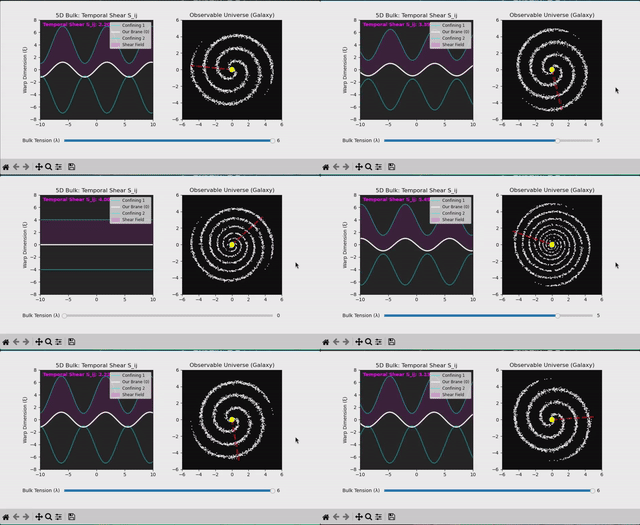
Differences in temporal phase introduce a form of temporal shear between branes, defined as:
$$ S_{ij} = \partial_\perp (t_i - t_j) $$
This shear contributes weakly to the effective stress–energy tensor on a brane, potentially affecting:
- Local curvature
- Effective energy density
- Long-term cosmological evolution and stability
4.4 Potential Observables
Although expected to be subtle, possible observational consequences include:
- Small modulations in galaxy rotation curves
- Anomalous dispersion or phase effects in gravitational wave propagation
- Oscillatory contributions to large-scale structure, potentially detectable by high-precision cosmological surveys
5. Aim of This Note
This document is intended to outline a speculative but internally coherent conceptual framework. No claim of physical correctness is made. Rather, the goal is to:
- Present a novel perspective for discussion
- Encourage critique from experts in brane cosmology and gravitational physics
- Explore whether temporal phase offsets merit further mathematical or phenomenological study
6. References
-
Randall, L., & Sundrum, R. (1999). A Large Mass Hierarchy from a Small Extra Dimension. Physical Review Letters, 83, 3370.
-
Khoury, J., Ovrut, B., Steinhardt, P., & Turok, N. (2001). The Ekpyrotic Universe: Colliding Branes and the Origin of the Hot Big Bang. Physical Review D, 64, 123522.
-
Rubakov, V. (2001). Large and Infinite Extra Dimensions. Physics-Uspekhi, 44, 871–893.
7. Disclaimer
Christian Sacks
Independent Researcher
This work is purely speculative and intended to encourage discussion and professional critique. The author has no formal training in physics, and all ideas presented herein should be treated as exploratory rather than authoritative.
8. Additional information
I have created also a working example using Python which you can download and run once you install python-matplotlib and python-tk using your favourite package manager.
You can see a video of what it looks like or an animated gif also.